Look closely at a sprinkler head and you'll see one of two thermal mechanisms: a colored glass bulb or a fusible link between two metal plates. This thermal element determines when the sprinkler activates — wrong temperature selection degrades fire performance and increases maintenance costs. NFPA 13's thermal classification system clarifies the selection.
Glass Bulb Color Codes
The liquid color inside the glass bulb tells you the sprinkler's operating temperature. NFPA 13's standard code:
| Bulb colour | Temperature (°C) | Temperature (°F) | NFPA 13 class |
|---|---|---|---|
| Orange | 57°C | 135°F | Ordinary |
| Red | 68°C | 155°F | Ordinary |
| Yellow | 79°C | 175°F | Intermediate |
| Green | 93°C | 200°F | Intermediate |
| Blue | 141°C | 286°F | High |
| Purple | 182°C | 360°F | Extra High |
| Black | 227-260°C | 441-500°F | Very Extra High |
European catalogues carry a few intermediate steps this table does not — 100°C and 121°C, and a mauve 163°C alongside the 182°C — together with typical spaces for each rating; those are listed in our complete sprinkler temperature and colour code table.
This color system standardized in the 1970s and is identical worldwide. A firefighter seeing a blue glass bulb in a Turkish warehouse instantly knows it'll activate at 141°C.
Response Time Index (RTI)
How fast a sprinkler responds is a separate measure: Response Time Index (RTI). Unit: (m·s)^0.5. Lower RTI = faster response.
| Type | RTI (m·s)^0.5 | Typical Application |
|---|---|---|
| Quick Response (QR) | < 50 | Light Hazard: hotel, residential, office |
| Standard Response | 80-350 | Ordinary Hazard: manufacturing, retail |
| ESFR | < 50 (special design) | High-piled storage |
Quick response advantage: opens early and suppresses/controls the fire at its start. Disadvantage: slightly more sensitive to heat accumulation (summer air heating, etc.), so slightly higher false-activation risk. NFPA 13 recommends QR for Light Hazard but doesn't mandate it.
Temperature Selection Logic
A sprinkler's operating temperature should be at least 30°C (50°F) above the expected maximum ambient temperature at the ceiling. This reduces false discharge risk. Examples:
- Office (ceiling 27°C): 68°C red bulb (27 + 30 = 57 < 68 ✓)
- Attic (summer 48°C): 93°C green (48 + 30 = 78 < 93 ✓)
- Boiler room (steady 80°C): 141°C blue (80 + 30 = 110 < 141 ✓)
- Industrial oven vicinity (100°C): 182°C purple (100 + 30 = 130 < 182 ✓)
Temperature Selection in Turkey
Turkish attic temperatures can reach 55-60°C in summer. Putting standard 68°C bulbs in an attic increases summer accidental activation risk. In Turkey's southwestern cities (Antalya, Muğla, Mersin), attic sprinklers should use 79°C yellow or 93°C green for safety.
Fusible Link
An older sprinkler type but still current. Instead of a glass bulb, two metal pieces held by low-melting-point solder. As heat rises, the solder melts, the pieces separate, and the sprinkler opens. Advantage: more tolerant of mechanical shock. Disadvantage: can't hold high loads at low temperatures (weaker).
The colour code moves with it. On a fusible link sprinkler there is no coloured liquid to read, so the code sits on the yoke arms instead, and each colour stands for a temperature range rather than one nominal value. The ranges below are the ones tabulated in our sprinkler temperature and colour code table:
| Yoke arm colour | Temperature range |
|---|---|
| Uncoloured | 57 – 77 °C |
| White | 80 – 107 °C |
| Blue | 121 – 149 °C |
| Red | 163 – 191 °C |
| Green | 204 – 246 °C |
| Orange | 260 – 302 °C |
| Black | 320 – 343 °C |
NFPA 13 and EN 12845: Same Colours, Different Language
The sprinkler itself does not change when you cross standards, and the colour codes overlap. What changes is the vocabulary used to describe a rating, which is where drawings and handover files go wrong on multi-standard projects.
- NFPA 13 names groups. A specification written to NFPA calls out Ordinary, Intermediate, High, Extra High or Very Extra High, and the glass bulb table above shows which colour falls in which group. Per our temperature and colour code comparison, the full NFPA group bands run Ordinary 57–77 °C, Intermediate 79–107 °C, High 121–149 °C, Extra High 163–191 °C, Very Extra High 204–246 °C and Ultra High 260–302 °C.
- EN 12845 states numbers. The European standard works with the nominal value — 68 °C, 93 °C, 141 °C — and does not use the group names at all. Its selection rule is the same one applied throughout this article: at least 30 °C above the highest anticipated ambient temperature, and no higher than necessary, because an unnecessarily high rating lengthens the response time and lets a small fire grow.
- Do not mix the two languages on one project. Labels, drawings, the equipment schedule and the handover file should all speak either group names or numerical values. A schedule that says "Extra High" next to a bulb marked 182 °C is readable to the designer and ambiguous to everyone who maintains the system afterwards.

MEP Calc — 86+ Engineering Calculators
MEP Calc bundles 86+ engineering modules in one iOS app: 21 fire calculations (sprinkler, fire pump, FM-200 clean agent) plus heating, cooling, HVAC, plumbing, steam and natural gas. Download it on the App Store.
Download MEP Calc on the App Store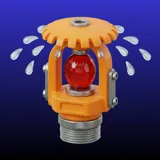
SprinkCalc — Fire Sprinkler Design Across Three Standards
SprinkCalc covers hazard classification, design density and area, K-factor selection, water demand and hydraulic calculations for NFPA 13, FM Global and BS EN 12845 in a single iOS app, and exports a professional PDF report. One of the few tools that unifies all three major fire protection standards.
Download SprinkCalc on the App StoreThree Common Mistakes
- Single temperature throughout the building: Using the same 68°C bulb in office + kitchen + boiler room. False activations happen in the kitchen.
- Low temperature in vacation properties: Coastal resort hotels need 79°C instead of 68°C.
- Confusing body color with bulb color: Sprinkler body color (chrome, brass, white) and glass bulb color are entirely separate.
Conclusion
Sprinkler thermal characteristics look simple, but they underlie 70% of false discharge events. Understanding the space, measuring maximum temperatures, and applying NFPA 13's ambient + 30°C rule is critical. If 4-5 different temperature classes are used in a building, the spare cabinet must cover this diversity.
Core reference: NFPA 13 - Installation of Sprinkler Systems (Chapter 6 Sprinklers). Original NFPA post: NFPA Today - Sprinkler Thermal Characteristics.